SEO takes time—but how much time? This is one of the most common questions businesses ask when investing in search engine optimization.
The short answer is that SEO typically takes 3–6 months to start showing meaningful results, while more competitive websites and industries may take 6–12 months or longer to achieve strong rankings. However, the timeline depends on several factors, including your website’s current authority, competition, technical SEO, content quality, backlinks, and the keywords you target.
Unlike paid advertising, where results can appear almost immediately, SEO is a long-term digital marketing strategy designed to build sustainable organic traffic and visibility.
In this guide, we’ll explain how long SEO takes to work, what happens during each stage, which factors affect SEO results, and what you can do to speed up your progress.
Key Takeaways
- SEO usually takes 3–6 months to produce noticeable results.
- New websites may require 6–12 months to build significant organic visibility.
- Low-competition keywords can rank faster than highly competitive keywords.
- Technical SEO and website improvements can produce early gains.
- Consistent, high-quality content is essential for long-term SEO growth.
- SEO results depend on competition, website authority, content, backlinks, and search intent.
- SEO should be treated as a long-term investment rather than a quick marketing campaign.
How Long Does SEO Take to Work?
For most businesses, SEO starts producing measurable improvements within 3–6 months when the website receives consistent optimization and high-quality content.
However, there is no universal SEO timeline.
A brand-new website targeting highly competitive keywords such as “digital marketing agency,” “SEO services,” or “best web design company” may take considerably longer to reach the first page of Google.
On the other hand, a website targeting specific long-tail keywords with lower competition may begin ranking within a few weeks or months.
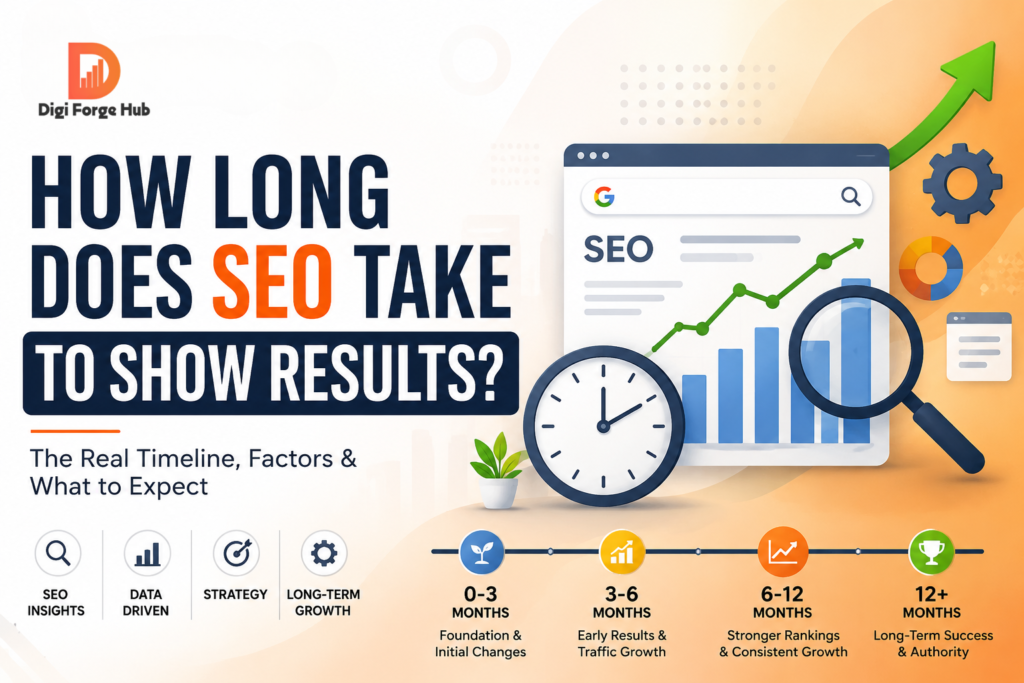
A realistic SEO timeline may look like this:
| SEO Period | What You May See |
|---|---|
| 0–3 months | Technical improvements, indexing, initial keyword movement |
| 3–6 months | Increasing impressions, rankings, and organic traffic |
| 6–12 months | Stronger rankings and consistent organic growth |
| 12+ months | Greater authority, traffic, leads, and competitive rankings |
These are general benchmarks rather than guarantees. Every website and industry is different.
Why Does SEO Take So Long?
Google needs time to discover, crawl, understand, and evaluate changes made to a website.
When you publish a new page, Google doesn’t automatically place it at the top of search results. Search engines evaluate many signals before deciding where a page should appear.
These can include:
- Content relevance
- Content quality
- Search intent
- Website authority
- Backlinks
- Technical SEO
- User experience
- Website structure
- Competition
- Historical website performance
SEO is therefore a process of building trust, relevance, and authority over time.
Think of SEO like building a reputation for your business. Publishing one article doesn’t establish authority overnight. Consistently creating useful content, improving your website, earning relevant links, and satisfying users can gradually strengthen your position in search results.
SEO Timeline: What Happens Month by Month?
Understanding the SEO process can help you set realistic expectations.
Month 1: SEO Audit and Foundation
The first month is usually focused on understanding the current state of your website.
An SEO audit may identify issues such as:
- Slow page speed
- Broken links
- Poor website structure
- Missing title tags
- Duplicate content
- Incorrect heading structure
- Mobile usability problems
- Indexing issues
- Missing or weak meta descriptions
- Poor internal linking
Keyword research should also be performed to identify the search terms your potential customers are using.
At this stage, you may not see dramatic traffic increases. The goal is to create a strong foundation for future growth.
Months 2–3: Optimization and Content Growth
Once the technical foundation is improved, the focus can shift toward content and on-page SEO.
This may include:
- Optimizing existing pages
- Publishing new blog content
- Creating service pages
- Improving internal links
- Optimizing images
- Targeting long-tail keywords
- Improving page titles and headings
- Matching content with search intent
You may start seeing an increase in Google Search Console impressions and keyword rankings during this period.
However, increased impressions don’t always mean immediate increases in traffic.
A page ranking on page three of Google may receive very little traffic. Moving that page to page one can make a much bigger difference.
Months 3–6: Rankings and Organic Traffic Begin Growing
This is when many businesses start noticing more meaningful SEO progress.
Your website may begin ranking for more keywords, and existing pages may move higher in search results.
You might see:
- More organic impressions
- More keyword rankings
- Increased organic clicks
- Higher rankings for long-tail keywords
- More visitors to blog posts
- Increased visibility for service pages
This is also the stage where SEO professionals analyze which pages and keywords are performing well and adjust the strategy accordingly.
SEO isn’t a “set it and forget it” process.
Continuous optimization is important.
Months 6–12: Building Authority and Consistency
After six months, a well-maintained SEO campaign can begin producing more consistent organic growth.
At this stage, businesses may focus on:
- Competitive keywords
- High-value commercial pages
- Link building
- Digital PR
- Content clusters
- Conversion optimization
- Updating older content
- Improving underperforming pages
- Building topical authority
The objective isn’t simply to generate traffic.
The objective is to attract qualified visitors who are more likely to become leads or customers.
7 Factors That Affect How Fast SEO Works
Several factors can speed up or slow down SEO results.
1. Website Age and Authority
Established websites often have an advantage because they may already have backlinks, indexed pages, historical data, and domain authority.
New websites usually need more time to establish credibility.
That doesn’t mean new websites can’t rank. They simply need to build authority strategically.
2. Keyword Competition
Keyword difficulty has a major impact on SEO timelines.
For example, ranking for a highly competitive keyword like:
“digital marketing agency”
can be significantly harder than ranking for a more specific keyword such as:
“digital marketing agency for small businesses in Pune.”
Long-tail keywords are often easier to target because they are more specific and may have less competition.
A smart SEO strategy usually combines:
- Low-competition keywords
- Medium-competition keywords
- High-value commercial keywords
- Long-tail keywords
- Location-based keywords where relevant
3. Content Quality
Publishing hundreds of low-quality articles doesn’t guarantee SEO success.
Search engines aim to provide useful and relevant information to users.
Your content should:
- Answer the user’s question
- Demonstrate expertise
- Be easy to read
- Provide practical information
- Match search intent
- Be original and useful
- Include relevant keywords naturally
Instead of asking, “How many keywords should I add?”
Ask:
“Does this page provide the best answer for the person searching this query?”
That mindset leads to better SEO content.
4. Technical SEO
Technical problems can prevent search engines from properly crawling and understanding your website.
Important technical SEO areas include:
- Website speed
- Mobile responsiveness
- HTTPS
- XML sitemap
- Robots.txt
- Canonical tags
- URL structure
- Internal linking
- Crawlability
- Indexability
- Core Web Vitals
Fixing technical SEO problems can sometimes produce relatively quick improvements because you’re removing barriers that may be preventing search engines from accessing or understanding your pages.
5. Backlinks and Website Authority
Backlinks remain an important part of SEO.
A backlink occurs when another website links to your website.
However, quality matters more than simply collecting a large number of links.
Relevant and trustworthy links can help strengthen your website’s authority.
Good link-building strategies can include:
- Digital PR
- Guest contributions
- Industry publications
- Useful resources
- Original research
- Expert commentary
- Partnerships
- Linkable content
Avoid buying large quantities of low-quality links simply to manipulate rankings. Poor-quality link-building can create more problems than benefits.
6. Your Industry
Some industries are naturally more competitive than others.
For example, industries such as:
- Finance
- Legal services
- Insurance
- Healthcare
- Real estate
- Digital marketing
- E-commerce
can have significant competition for valuable keywords.
If hundreds of established websites are already competing for a keyword, ranking may require considerably more resources and time.
7. Consistency
One of the biggest SEO mistakes businesses make is stopping too early.
A company may publish five blog posts, wait two months, see limited results, and conclude that SEO doesn’t work.
SEO usually requires consistency.
Successful campaigns often involve ongoing:
- Content creation
- Keyword research
- Technical optimization
- Internal linking
- Content updates
- Competitor analysis
- Link acquisition
- Performance monitoring
Consistency helps your website build authority over time.
How Can You Make SEO Work Faster?
There is no legitimate shortcut that guarantees first-page rankings.
However, you can improve your SEO efficiency by focusing on the activities most likely to generate results.
Start With Low-Competition Keywords
Instead of immediately targeting extremely competitive keywords, identify relevant long-tail keywords that your website has a realistic chance of ranking for.
Optimize Existing Content
Sometimes improving an existing page is faster than creating a completely new page.
Look for pages that already receive impressions but rank around positions 8–30. Improving their content, structure, internal links, and search intent alignment may help them move higher.
Create Topic Clusters
Instead of publishing unrelated articles, create multiple pieces of content around a central topic.
For example, a digital marketing website could create a topic cluster around SEO:
- What Is SEO?
- How Long Does SEO Take?
- SEO vs PPC
- Local SEO Guide
- Technical SEO Checklist
- Keyword Research Guide
- On-Page SEO Guide
These pages can be internally linked to create a stronger topical structure.
Improve Internal Linking
Internal links help users navigate your website and help search engines understand the relationship between pages.
Link relevant blog posts to important service pages where appropriate.
Monitor Your Data
Use tools such as Google Search Console and Google Analytics to understand:
- Which keywords are generating impressions
- Which pages receive organic traffic
- Which pages are losing rankings
- Which queries have high impressions but low click-through rates
- Which content generates leads
Use this data to continuously improve your SEO strategy.
How Do You Know If SEO Is Working?
Don’t judge SEO only by whether one keyword reaches position one.
SEO progress can be measured through several metrics.
Important SEO Metrics
Organic Traffic:
Are more people visiting your website through search engines?
Impressions:
Is your website appearing more frequently in search results?
Keyword Rankings:
Are your target keywords moving toward page one?
Click-Through Rate:
Are people clicking your pages when they appear in search results?
Organic Leads:
Are search visitors contacting your business?
Conversions:
Are organic visitors becoming customers?
Ultimately, business results matter more than rankings alone.
A keyword ranking #1 is not very valuable if it doesn’t attract relevant customers.
SEO vs PPC: Which Produces Faster Results?
If you need immediate visibility, paid advertising can produce traffic much faster than SEO.
SEO and PPC, however, serve different purposes.
| SEO | PPC |
| Long-term strategy | Short-term visibility |
| Organic traffic | Paid traffic |
| Takes time to build | Can generate traffic quickly |
| Builds website authority | Requires ongoing ad spend |
| Can produce sustainable traffic | Traffic usually stops when ads stop |
For many businesses, the strongest strategy is to use SEO and PPC together.
PPC can generate immediate traffic while SEO builds long-term organic visibility.
Should You Stop SEO If You Don’t See Results After 3 Months?
Not necessarily.
Three months may be enough to identify early movement, but it doesn’t always mean you should expect major revenue growth.
Instead of asking:
“Why aren’t we ranking #1 yet?”
Ask:
- Are impressions increasing?
- Are more keywords ranking?
- Are pages moving upward?
- Is organic traffic growing?
- Are new pages getting indexed?
- Are conversions improving?
- Are we targeting the right keywords?
- Is our content better than competing pages?
SEO is a process of continuous improvement.
If there is absolutely no progress after several months, it may be time to reassess the strategy, technical SEO, content quality, keyword targeting, competition, and link profile.
How Long Should You Invest in SEO?
SEO should generally be viewed as an ongoing marketing channel rather than a one-time project.
A website can continue benefiting from SEO long after individual articles are published.
As your website builds more authority and content, you can potentially rank for hundreds or thousands of relevant search queries.
The goal should be to create a sustainable organic traffic engine that continues bringing qualified visitors to your business.
Final Thoughts: How Long Does SEO Really Take?
So, how long does SEO take to show results?
For many businesses, 3–6 months is a realistic timeframe for seeing meaningful early results, while stronger and more competitive results can take 6–12 months or longer.
But SEO isn’t about waiting for a specific date.
It’s about continuously improving your website, publishing useful content, targeting the right keywords, building authority, and measuring what works.
The businesses that usually benefit most from SEO are those that treat it as a long-term investment rather than expecting overnight rankings.
If you want sustainable organic traffic, qualified leads, and stronger online visibility, starting sooner gives your website more time to build authority.
SEO takes time—but the right strategy can turn that time into long-term growth.
Frequently Asked Questions About SEO
1. How long does SEO take to show results?
SEO can start showing early improvements within a few months. Many businesses see more meaningful results around 3–6 months, while competitive websites may require 6–12 months or longer.
2. Can SEO results happen in one month?
Yes, some changes can produce improvements within a month, particularly when fixing technical problems or targeting low-competition keywords. However, significant organic growth usually takes longer.
3. Why is my website not ranking on Google?
Possible reasons include high keyword competition, weak content, technical SEO problems, poor search intent alignment, limited website authority, insufficient backlinks, or indexing issues.
4. Is SEO better than PPC?
Neither is universally better. SEO is generally better suited for long-term organic visibility, while PPC can provide faster paid traffic. Many businesses benefit from using both strategies.
5. Does blogging help SEO?
Yes. High-quality blog content can help a website target additional search queries, answer customer questions, build topical authority, and attract organic traffic.
6. How long does local SEO take?
Local SEO timelines vary depending on competition, location, website authority, Google Business Profile optimization, reviews, citations, and content. Local businesses may see improvements within a few months, but competitive locations can take longer.
7. Can I guarantee first-page Google rankings?
No legitimate SEO professional can guarantee a specific Google ranking or exact timeline. Search rankings depend on many factors that can change over time.