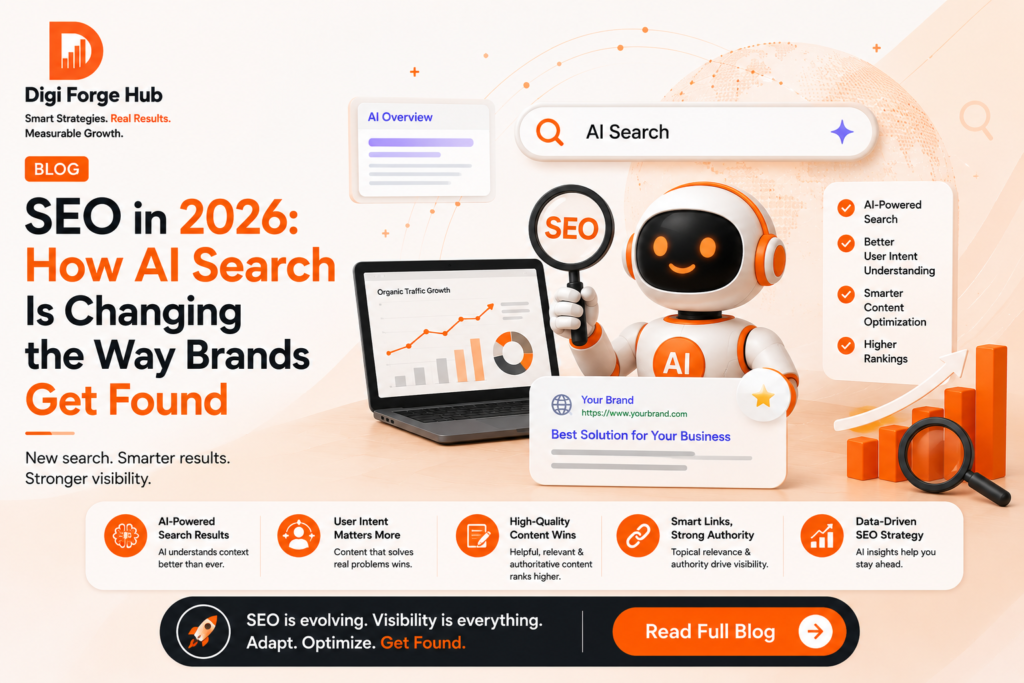
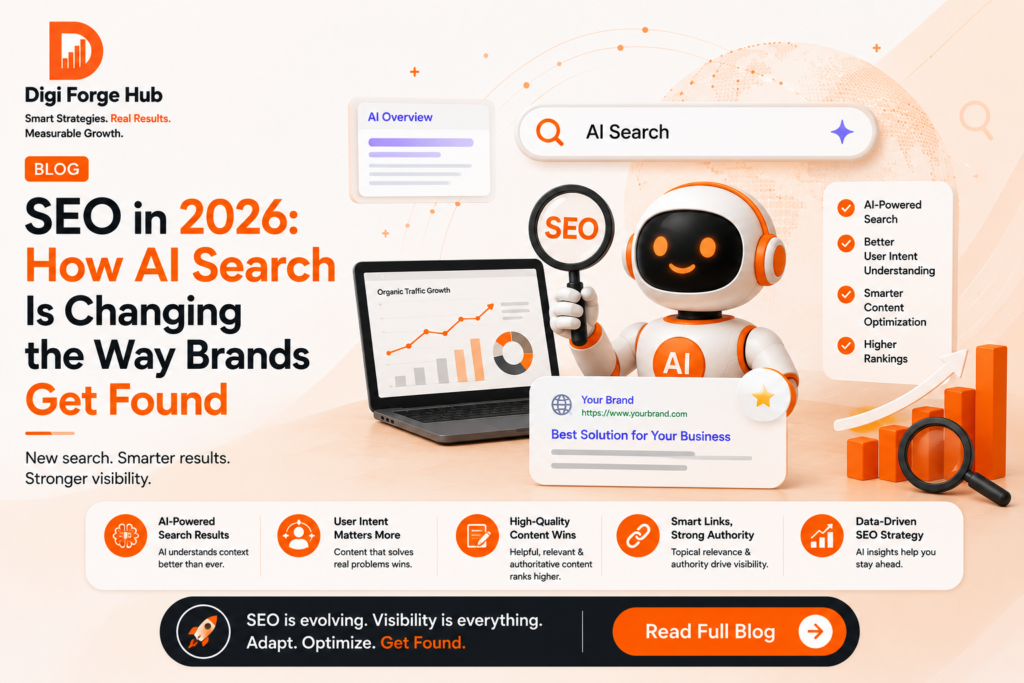
For twenty years, “SEO” meant one thing: rank higher on a page of ten blue links. That game isn’t gone, but it’s no longer the whole game. In 2026, a huge share of searches never produce a click at all — the answer just appears, synthesized by an AI system, right there on the results page or inside a chat window. If your brand isn’t part of that synthesized answer, you may as well not exist for a growing slice of your audience.
This is the shift brands need to understand this year: search has split into two parallel tracks — traditional ranking and AI-generated answers — and winning only the first one is no longer enough.
Zero-click search is now the default, not the exception
Search behavior has fundamentally changed. A large and growing majority of searches now end without a single website visit, because AI Overviews, chat-based assistants, and answer engines resolve the query directly. Click-through rates on traditional organic listings have fallen sharply as a result. For marketers used to measuring success by rank position and traffic, this is uncomfortable — the old scoreboard doesn’t capture what’s actually happening anymore.
The practical implication: visibility now has to be measured in more places than a SERP. Are you being cited inside an AI Overview? Are you the source an assistant like ChatGPT, Gemini, or Perplexity references when it answers a question about your category? That’s a different kind of “ranking,” and it requires different instrumentation and different content decisions.
Meet the new acronyms: GEO, AEO, LLMO, and GXO
A cluster of new disciplines has emerged to describe this work, and while the terminology is still settling, the distinctions are useful:
- GEO (Generative Engine Optimization) — optimizing content so generative AI systems can retrieve, understand, and cite it when producing an answer.
- AEO (Answer Engine Optimization) — structuring content to directly answer specific questions, aimed at featured snippets, AI Overviews, and voice assistants.
- LLMO (Large Language Model Optimization) — making content easier for language models to parse, extract, and reuse accurately.
- GXO (Generative Experience Optimization) — a newer, forward-looking layer focused on autonomous AI agents and agentic commerce, where the “searcher” may eventually be a bot acting on a person’s behalf rather than the person themselves.
None of these fully replace SEO. Think of them as specialized lenses on the same underlying goal: be the source that gets found and trusted, whether the “user” is a human scanning a page or a model generating a paragraph.
What AI systems actually reward
AI search doesn’t rank pages the way classic search engines do. It retrieves and synthesizes information based on relevance, semantic meaning, and trustworthiness, often pulling specific passages rather than whole pages. A few implications follow directly from that:
1. Passage-level, not just page-level, optimization matters. AI retrieval systems increasingly work with dense vector embeddings and pull specific chunks of a page rather than crawling it top to bottom. Content that’s broken into clear, self-contained, semantically coherent sections — with direct answers close to the question they address — is far more retrievable than a wall of loosely connected prose.
2. Structure is not optional. Clean headings, logical paragraph breaks, well-marked lists, and structured data (schema markup) all help AI systems parse what a page is actually saying. Content that’s technically correct but poorly organized is much less likely to get pulled into an answer.
3. E-E-A-T has become a trust filter, not a checkbox. Experience, expertise, authoritativeness, and trustworthiness were always part of Google’s guidelines, but AI systems lean on these signals even harder, because they’re effectively vouching for a source when they cite it. Thin, unoriginal, or unverifiable content gets filtered out of the retrieval pool before it ever has a chance to be cited.
4. Entities matter more than keywords. AI search increasingly reasons about the relationships between brands, products, people, and topics as connected entities rather than isolated keyword matches. Building a clear, consistent entity presence — through structured data, consistent naming, and content that reinforces what your brand is and does — helps AI systems place you correctly in that web of relationships.
5. Site performance still gates everything. Pages that load slowly or are poorly structured often fail to enter the AI retrieval pool at all, regardless of how good the content is. Technical SEO hasn’t become irrelevant — if anything, it’s a harder prerequisite than before, since AI crawlers need fast, clean access to evaluate content in the first place.
Brand authority is quietly becoming the differentiator
Here’s a tension worth naming: most marketing teams are still doing the classic brand-authority work — backlinks, digital PR, consistent publishing — but fewer of them are treating it as a deliberate strategy anymore. It’s become background noise, routine work rather than a competitive lever.
That’s a mistake in an AI-search world, because authority signals are exactly what generative engines use to decide who’s trustworthy enough to cite. A brand with strong, consistent third-party validation — real mentions, real citations, a coherent public presence across the web — has a structural advantage in getting surfaced by AI systems, independent of any single piece of content. Brand building and AI visibility are no longer separate workstreams; they’re the same workstream viewed from two different angles.
What this means for a 2026 content strategy
A few practical shifts worth making now:
- Write to be extracted, not just read. Lead with direct, concise answers to the specific questions your audience is asking, then expand with supporting detail and context.
- Go conversational. Voice search and chat-based queries tend to be longer and more natural-language than typed keyword searches — optimize for how people actually ask questions, not just how they type them into a search box.
- Invest in structured data. Schema markup helps AI systems understand what your content is and how it relates to other entities, making it easier to retrieve accurately.
- Track new metrics. Traffic and rank position still matter, but so does citation frequency in AI Overviews and chat answers — start monitoring where and how often you’re being referenced, not just where you rank.
- Don’t abandon local and multi-surface visibility. AI systems evaluate local authority signals — reviews, location-specific content, local press mentions — the same way they evaluate topical authority, so local SEO fundamentals still carry real weight.
The bottom line
SEO in 2026 isn’t dead — it’s expanding. The fundamentals of good content, technical performance, and genuine authority still matter; they’re just being evaluated by a new kind of reader that synthesizes rather than lists. The brands that adapt fastest are treating AI visibility as a natural extension of good SEO practice, not a separate discipline bolted on top of it. The ones that don’t are discovering, often through a slow decline in traffic they can’t quite explain, that being “findable” and being “cited” have quietly become two different things — and only one of them is optional anymore.